Category: Press

Featured articles, interviews, and media mentions from industry magazines, news platforms, and partner websites.

  • Untitled post 13428

    Press Report

    Reliable High-Speed Can Filling at Estrella Damm

    The Damm brewery in Barcelona relies on inspection technology from BBULL Technology to monitor its high-performance canning line.

    Customer Estrella Damm / Damm Brewery
    Application High-Speed Can Inspection
    Systems IMAGE ECI & IMAGE 360
    Source BRAUINDUSTRIE 10/2025

    Reliable High-Speed Can Filling

    Estrella Damm relies fully on BBULL systems for can inspection

    The Damm brewery in Barcelona looks back on almost 150 years of history and is now one of the largest breweries in Spain. A significant share of its production is exported to Portugal and England. At the modern brewery, filling is carried out mainly in cans. For inspection of integrity, foreign object detection, matching of contents and printed design, as well as completeness and readability of the best-before date, Damm relies on inspection technology from BBULL Technology in Königsbach-Stein.

    A brewery with history and modern production

    The brewery was founded in 1876. Its flagship brand, Estrella Damm, is still brewed according to the original recipe. In addition to Estrella Damm, other beers such as Voll Damm, the gluten-free Daura and Inedit are produced in Barcelona. Today, the brewery also produces and fills a wide range of non-alcoholic beverages.
    The brewery’s production areas are spaciously designed. The white-and-red brewery site houses four large bottling lines, two high-speed keg lines and three powerful canning lines. The capacity of the canning lines ranges from 60,000 to 90,000 cans per hour.

    Almost everything runs automatically

    In the canning halls, the high level of automation is especially noticeable. Empty cans are retrieved from extensive storage areas, pallets are transported and fed to the depalletizers. Many of these steps are handled by autonomous forklift vehicles.
    The aluminum cans then move at high speed through the hall on special conveyors. They are rinsed, checked for damage and foreign objects, and inspected to ensure that they match the intended filling product. The cans are then filled, sealed, pasteurized and palletized.
    The brewery also uses modern solutions for packaging. Multipacks such as 6-, 8- or 12-packs are no longer wrapped in plastic film, but grouped with cardboard. According to Javier Sanchez, project engineer and member of Damm’s technical management team, the brewery was an early adopter of this approach in Spain.
    Can and contents must match
    Due to strong sales growth, production has been continuously expanded in recent years. One key project was the new canning line 19. The line was designed for an output of up to 90,000 cans per hour and runs around the clock during peak season.
    For Damm, maximum safety was essential. Damaged or deformed cans could cause serious problems in the filler or seamer. At the same time, it must be ensured that the contents and printed design of each can match exactly. A mix-up would be particularly critical for alcohol-free or gluten-free products.
    Each product therefore carries a unique barcode that must be checked and verified. A correctly applied and fully readable best-before date is just as important. Faulty or incompletely printed cans must be reliably detected and rejected.

    BBULL Technology supplies multi-camera system

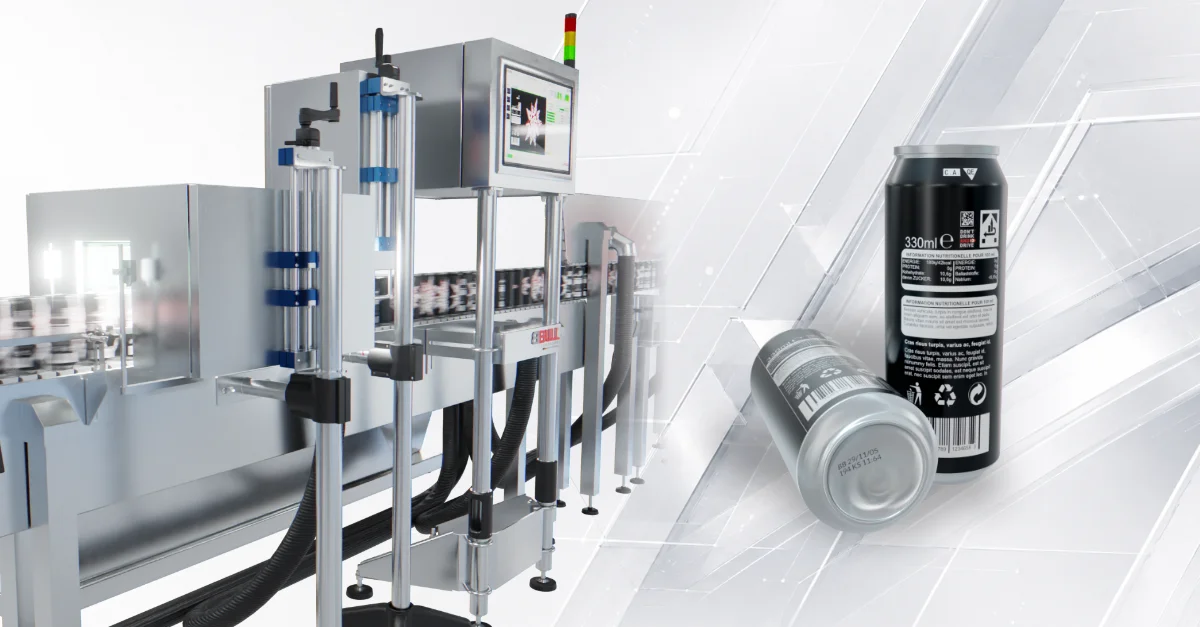
    After a thorough evaluation, Damm chose BBULL Technology. For canning line 19, BBULL supplied a multi-camera system consisting of the IMAGE ECI empty can inspection system and the IMAGE 360 label and decoration inspection system.
    The BBULL Technology group from Königsbach-Stein has specialized for decades in inspection systems, sorting and distribution technology, as well as transport and conveyor technology for the beverage and food industries. In Germany, BBULL develops and manufactures numerous container and packaging inspection systems, as well as customer- and product-specific sorting, distribution and rejection systems.
    In Spain, the project was carried out in cooperation with Sicopack, BBULL’s local partner for sales and service.

    IMAGE ECI checks for deformation, damage and contamination

    IMAGE ECI is used for early detection of damage and contamination. The aim is to minimize waste, prevent disruptions at the filler and seamer and, in the worst case, avoid product recalls.
    The system detects even small defects and contaminants using special camera optics and lighting for the relevant areas of the can. It is suitable for common can sizes and can be used regardless of material, such as steel or aluminum.
    Inspection points include the can flange, top panel, roundness, dents, contamination on the bottom and the inner side wall. High-performance cameras capture images of every can. Ring light illumination ensures uniform lighting. Faulty cans are reliably rejected. Operation and visualization are handled via a 21-inch color display.

    IMAGE 360 verifies print, barcode and best-before date

    Downstream, IMAGE 360 checks the correct product type via barcode at high filling speeds. This ensures that contents and design match. Multiple cameras capture the product from different angles and provide a comprehensive view.
    The images are combined and processed by the software. The system analyzes shapes and colors and compares them with predefined standards. It then detects the correct filling date and best-before date on the can bottom. Cans with detected defects or issues are reliably rejected.

    Transport technology as the basis for stable inspection

    Another project partner was HF Meyer from Neustadt in Holstein. The company specializes in can handling and contributed its experience with can conveyors, vacuum bridges and can rinsers.
    For the Damm project, HF Meyer supplied special conveyors to ensure that the containers always assume a precisely defined position under the inspection unit. In addition, a vacuum tunnel is used to hold the cans from above. This allows them to be reliably marked with filling and best-before dates. The tunnel is used for inkjet coding and is already prepared for later laser coding.

    Promised — and delivered

    For Damm, it was crucial to reliably detect every single can, even with minimal spacing between them. A small gap between the containers helps keep the line stable at high speed without unnecessarily pushing the limits of process safety.
    Javier Sanchez summarizes the result positively: BBULL promised very high reliability and delivered on that promise in the project.
    Source note
    Text basis: Bert Brosch, published in BRAUINDUSTRIE 10/2025. Published on bbull.com with the kind permission of the author. This text was editorially cleaned up from a scanned source and structured for web presentation.
    Optional note in the article: You can view the original article as a PDF here.

    Source: Text: Bert Brosch. Published in BRAUINDUSTRIE 10/2025. Published on bbull.com with the kind permission of the author.
    View original german article as PDF
  • Romina Mineralbrunnen relies on AI from BBULL Technology

    Romina Mineralbrunnen relies on AI from BBULL Technology

    Innovative Empty Crate Inspection with AI at Romina Mineralbrunnen

    Romina Mineralbrunnen in Reutlingen has been leveraging BBull Technology’s deep learning systems for years to ensure precise empty crate inspection. Using artificial intelligence, the system handles even complex challenges like tethered closures and diverse bottle shapes across glass and PET lines. The result: fewer errors, enhanced efficiency, and nearly flawless recognition. Discover how cutting-edge technology makes a real difference.

    Note: The original article is available in German only.
    It highlights how Romina Mineralbrunnen, a beverage producer near Stuttgart, processes 178 million glass and PET bottles annually using BBull Technology’s AI-driven inspection systems. These systems ensure reliable detection of foreign objects, incorrect bottles, and defects such as damaged closures or tethered caps. By combining high-resolution cameras, advanced lighting, and self-learning algorithms, the technology adapts to new bottle designs and materials with ease. Romina Mineralbrunnen reports significantly reduced crate rejections, enhancing operational efficiency. The article also discusses how BBull’s systems are used for PET recycling by accurately separating non-compliant bottles, ensuring smooth downstream processing.

    Broesele GmbH
    www.broesele.de
    Erschien in der Ausgabe 11/2024 des Fachmagazins “Flüssiges Obst”


  • Bad Dürrheimer relies on empties inspection from BBull

    Each correct bottle is cash

    Not long ago, the Bad Dürrheimer Mineralbrunnen received an innovation award for its 1-liter “Légère” glass bottle with an extra-large mouth. The fountain from the Black Forest fills 60 percent of its waters and sweet drinks in glass bottles. In the case of PET, there are disposable bottles that are shrink-wrapped in multipacks and three different PETCycle bottles that are sold in crates. For these PETCycle containers, the fountain has an agreement with the licensor in Bad Neuenahr, where the deposit is charged to retailers. Bad Dürrheimer, however, is a “net reporter,” which means that all missing bottles or incorrect bottles that come back with the crates are themselves reported to the head office and must therefore be accounted for quite accurately. Only the “correct” bottles with the distinctive octagonal or decagonal neck ring can be accounted for, all others have to be sorted out. For this, the fountain relies on the tried-and-tested Compact LG 500 universal empties management system from the specialist BBull Technology in Königsbach-Stein.

    Water from plateau

    In 1956, the then mayor and spa director Otto Weissenberger found the best mineral water near Bad Dürrheim, today located in the Schwarzwald-Baar district next to the central town of Villingen-Schwenningen. Two years later, Adelbert Vogt and Klaus Dettling from Freiburg founded the mineral water company “Dürrheimer Johannisquelle Vogt KG”. On May 23, 1959, the first bottle rolled off the production line. The slogan at the time was “Vom Quell her gut” (“Good from the source”). Since then, production capacities have been continuously expanded. More than 120 million bottles are filled annually from seven mineral water springs and one medicinal water spring, all located in the close vicinity of the spa town of Bad Dürrheim. The 150 employees process 60 percent into seven different glass bottles, 40 percent into three different PET cycle bottles (0.5l, 1.0l, and 1.5l), plus 0.75l non-refillable PET. “With the two brands Bad Dürrheimer and Wittmansthaler, three different waters, one medicinal water, and 25 different sweet beverages, we are well positioned. Our sales area is the south of Baden-Württemberg, but our products can also be found in the Rhineland, southern Hesse and the Palatinate. Our sales team is on the road in this region. Our own fleet of 15 modern trucks, as well as contract carriers who have been working for us for many years, take care of deliveries to our customers,” reports the head of maintenance, Jürgen Lauble.

    Exact empties detection without X-rays

    The PETCycle bottles are blown from the well itself and then filled at a rate of 22,000 bph. The line runs in two shifts in winter and three shifts in summer, so all the machines on the line have to be extremely reliable. “We were looking for a system that could reliably detect empties: crates with missing bottles, glass bottles, or other PET bottles. For billing reasons, we have to be quite sure of detecting the exact number of bottles with octagonal or decagonal neck rings. In addition, we don’t want to have an X-ray source in the entire plant, so this detection system also had to be without radioactive X-rays. And no one but BBull could offer us that!” reports Markus Link, head of the electrical workshop.

    The choice then very quickly fell on the universal BBULL 500 “Compact LG” empties management system. It is characterized by a very compact, space-saving design. A measuring bridge is located in a stainless steel housing, which contains a universal ultrasonic line with up to 16 individual sensors. The basic image processing module consists of a color camera and a telecentric optics, this prevents a distortion of the objects with an excellent resolution, so any defects or deviations are detected very reliably. In the higher expansion stage, which is also in use in Bad Dürrheim, two cameras and two different lighting technologies are installed.

    Special lighting and optics for bottle type detection

    The use of the universal ultrasonic line eliminates the need to adapt the sensors to different crate formats and bottle positions. The activation of the respective sensor information is software-controlled without operator intervention. This minimizes setup times and largely prevents errors caused by incorrect operation. The basic system with a camera and telecentric optics generates an image recording of the entire crate width for each row of bottles. The individual images taken are combined by means of software to form an overall image with true-to-detail reproduction.
    The task at the Bad Dürrheimer Mineralbrunnen required the equipment of an additional optical module. This extension module includes an additional camera and an additional LED UV illumination. Both cameras take one image per row of bottles, the first in the daylight spectrum, the second in the ultraviolet range. The individual images generated in this way are combined after the crate has been passed through and examined by the recognition software for the bottle features that can be detected in each case. Each crate is thus examined in two independent images. The different illumination methods can be used to inspect features such as contours, labels, or especially the carrying rings, which are not visible in the basic configuration or are obscured by other features. The low-wear, high-performance LED lighting modules are deliberately installed above the conveyor level and are therefore protected against soiling and damage, which minimizes maintenance.

    Exceptional detection software

    Outstanding part of the BBull empties management system is the application of the universal image processing software “BBULL IMAGE”. Every single sensor and camera delivers raw data to this software. The height information of the ultrasonic sensors is converted into gray values so that the image processing software generates a three-dimensional image of the container to be examined. Scalable evaluation algorithms are then used to make an assessment of the contents and the box. Here, links and dependencies of different features are adjustable, so that an extremely high detection reliability is given, even under variable conditions. The software contains an extensive database function, which ensures storage and recognition of a wide variety of box types.

    Enormous number of features are detected

    Up to 7000 crates per hour can be precisely controlled. They enter the system and are stopped for a short moment. A second conveyor then pulls crate by crate, one at a time and with a small gap, and passes them under the measuring bridge. Powerful LEDs in different colors, a dual lighting module and ultrasonic sensors check the crate for a wide range of criteria as it passes through: Foreign objects, lying, broken or upturned bottles, damage or deformation to the crate, is a bottle missing or are one or more “wrong” bottles (made of glass or without the distinctive octagonal or decagonal neck ring) in the crate. It would also be possible to detect the cap or crate label, as well as the crate format and color, but these criteria do not play a role at the mineral water bottling plant. The entire system is controlled by a central operating and processing unit in a stainless steel housing and a logical 13″ touch-screen user interface.

    Errors sorted out and fixed manually

    All crates with one or more defects are gently transferred by the pneumatic “sinus sorter” to a parallel conveyor for manual defect removal. Incorrect bottles are removed and collected in large bags, after which the crate is placed back into the production flow. “If we’re running liter bottles and 9-bottle crates, then we’re taking out about two big bags of wrong bottles per shift. But if we fill 0.5 (20-bottle crates) or 1.5-liter (6-bottle crates), then there are eight to ten bags in a shift. Every wrong or missing bottle is cash money for us, because we offset the total bottles against the deposit from PETCycle headquarters. That’s why the PETCycle people also took a close look at the BBull machine and declared it to be very good,” reports the head of business administration, Günter Höfler.

    Bad Dürrheimer and PETCycle convinced by BBull system

    All sorted bags are examined once again, bottle by bottle, at a special sorting center run by a service provider to determine whether they are disposable or reusable deposit bottles. This is then also charged for. “On average, there are between 5 and 8 percent of incorrect bottles in the returned empties – of course, we want to be sure to identify all of these, because otherwise we’d pay on top! After all, each of our bottles has a deposit value of 25 cents,” says Markus Link. According to him, BBull’s empties management system exactly meets the specifications the fountain had. “The system is very logically designed and easy to operate; during our regular tests with prepared bottles and crates, we see very clearly that all faults are detected and safely rejected. We tested the machine for a few months and have now fully adopted it – it’s the perfect solution for us!”


  • Fruit flavor, cup and board fit together one hundred percent.

    Milchwerke Berchtesgadener Land Chiemgau eG in Piding fills each of its 16 different fruit yogurt varieties in its own cups and lids. To ensure that there is never a “wrong” filling, cup or tray – to avoid recalls – the company is the first in Germany to use the camera-based control system “BBull Tray Inspection”.

    Each fruit yogurt with variety cup and lid

    Four types of fruit are filled simultaneously on the filling line, up to 21,000 cups per hour – too much for manual inspection. “It must be ensured that 100 percent of the time the right fruit is sealed in the right cup with the correct sinker. The main issue is the “problem” of allergies, and this applies very specifically to our hazelnut yogurt, which is now being added to the range with variety cups,” explains Florian Lexhaller, the Technical Manager. Martin Hirschhalmer, head of the sour milk production department, adds: “We change over the four varieties five or six times a day. On the one hand, the cup stacks received from the packaging supplier can always contain the wrong cups, and the operating personnel who insert cups and blanks can make a mistake during the daily routine. We now have this inspection machine from BBull so that we can rule this out in the finished yogurts,” says Hirschhalmer.

    Translated with www.DeepL.com/Translator (free version)

    Two cameras for the buckets, three for the boards

    BBull Technology installed two high-performance cameras at the cups, each monitoring four stacks of cups and recognizing the varieties via a special color marking on the cup. If the system notices an incorrect cup in the stack, the machine stops immediately and the error is shown on the color display – even before the wrong cup has been filled. If an error occurs during insertion of the blanks, the operator no longer sees this after insertion because the blanks are stuck upside down in the magazine. To detect the error anyway, before the trays are on their way to palletizing, BBull installed three more high-resolution color cameras. Each tray is captured in razor-sharp detail and each individual yogurt cup is inspected: is there a blank on each cup at all, does each blank match the filled variety 100 percent, and was the blank applied cleanly. “The system also checks the BBD – whether it is present, but also whether it is complete, clearly legible and correct in terms of content,” praises Lexhaller, the technical manager.

    Each error is ejected

    If the system detects an error, the tray is ejected, the error is shown on the display and the operator can manually exchange the corresponding tray. If five trays in succession show errors, the machine stops automatically, because then either blanks have been inserted incorrectly or the MHD inkjet printer is working incorrectly. “In this way, we detect irregularities very quickly and not many trays later or even on the finished pallet,” says Martin Hirschhalmer.


GDPR Cookie Consent with Real Cookie Banner